
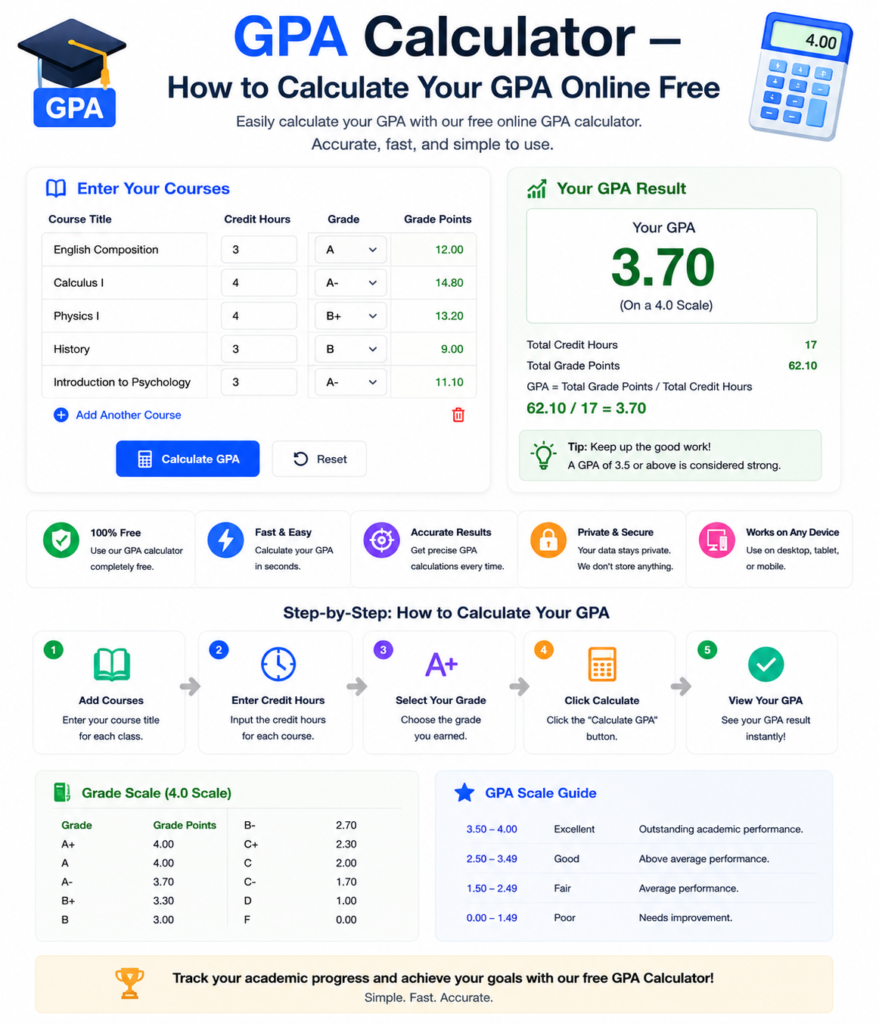
Your GPA is one of the most important numbers in your academic life. It determines scholarship eligibility, college admissions, graduate school applications, and even some job opportunities. Yet many students have no idea how it’s actually calculated — or whether theirs is where it needs to be.
This guide explains exactly how a GPA calculator works, how GPA is calculated, what counts as a good GPA, and how to use one online for instant results.
What Is GPA?
GPA stands for Grade Point Average. It’s a standardised way of measuring academic performance by converting letter grades into numerical points and averaging them across all courses.
Most schools in the United States — and many internationally — use a 4.0 GPA scale, where:
- 4.0 = A (Excellent)
- 3.0 = B (Good)
- 2.0 = C (Average)
- 1.0 = D (Below average)
- 0.0 = F (Failing)
Your GPA is the weighted average of all your grade points — weighted by credit hours, so courses worth more credits have more impact on your overall GPA.
How to Use the GPA Calculator Online
Use the free GPA calculator at OneClickPDFConvert for instant results — no maths required:
Step 1 — Open the GPA Calculator
Go to oneclickpdfconvert.com and select GPA Calculator. Opens instantly — no account needed.
Step 2 — Enter Your Courses
For each course, enter:
- Course name (optional — for your reference)
- Grade received (A, B+, C, etc. or the percentage)
- Credit hours for that course
Step 3 — Add All Courses
Click “Add Course” to enter additional subjects. Include every course from the semester or academic year you want to calculate.
Step 4 — Calculate
Click Calculate. Your GPA displays instantly — along with total credit hours and grade points earned.
How GPA Is Calculated — Step by Step
Understanding the calculation helps you plan your grades strategically. Here’s how it works:
Step 1 — Convert Grades to Grade Points
Each letter grade has a corresponding grade point value on the 4.0 scale:
| Letter Grade | Percentage | Grade Points (4.0 scale) |
|---|---|---|
| A+ | 97-100% | 4.0 |
| A | 93-96% | 4.0 |
| A- | 90-92% | 3.7 |
| B+ | 87-89% | 3.3 |
| B | 83-86% | 3.0 |
| B- | 80-82% | 2.7 |
| C+ | 77-79% | 2.3 |
| C | 73-76% | 2.0 |
| C- | 70-72% | 1.7 |
| D+ | 67-69% | 1.3 |
| D | 63-66% | 1.0 |
| D- | 60-62% | 0.7 |
| F | Below 60% | 0.0 |
Step 2 — Multiply Grade Points by Credit Hours
For each course: Quality Points = Grade Points × Credit Hours
Step 3 — Add Up Quality Points and Credit Hours
Total Quality Points = sum of all individual quality points Total Credit Hours = sum of all credit hours
Step 4 — Divide
GPA = Total Quality Points ÷ Total Credit Hours
Example Calculation
| Course | Grade | Grade Points | Credits | Quality Points |
|---|---|---|---|---|
| Mathematics | A | 4.0 | 3 | 12.0 |
| English | B+ | 3.3 | 3 | 9.9 |
| History | B | 3.0 | 2 | 6.0 |
| Chemistry | A- | 3.7 | 4 | 14.8 |
| Art | C+ | 2.3 | 1 | 2.3 |
| Total | 13 | 45.0 |
GPA = 45.0 ÷ 13 = 3.46
What Is a Good GPA?
What counts as a “good” GPA depends on your goals — but here’s a general guide:
- 4.0 — Perfect GPA. Exceptional academic performance.
- 3.7 – 3.9 — Outstanding. Competitive for top universities and scholarships.
- 3.5 – 3.7 — Very good. Qualifies for most honour rolls and merit scholarships.
- 3.0 – 3.5 — Good. Above average. Competitive for most graduate programs.
- 2.5 – 3.0 — Average. Meets minimum requirements for most schools.
- 2.0 – 2.5 — Below average. May limit opportunities for advanced programs.
- Below 2.0 — Academic probation risk at many institutions.
Cumulative GPA vs Semester GPA — What’s the Difference?
Two GPA numbers matter in most academic settings:
- Semester GPA — Your GPA for one specific semester only. Calculated using only the courses and grades from that term.
- Cumulative GPA — Your overall GPA across all semesters combined. This is what appears on transcripts and matters most for scholarships, admissions, and employers.
A strong semester GPA can raise your cumulative GPA — but slowly, because all previous semesters are included in the average. This is why recovering from a bad semester takes consistent effort over time.
Weighted GPA vs Unweighted GPA
High school students often encounter two types of GPA:
Unweighted GPA
Uses the standard 4.0 scale regardless of course difficulty. An A in a regular class and an A in an Advanced Placement (AP) class both count as 4.0.
Weighted GPA
Gives extra points for harder courses. AP, IB, and Honors classes often add 0.5 or 1.0 extra points to the grade value. This means a weighted GPA can exceed 4.0 — sometimes reaching 5.0 or higher.
College admissions offices typically recalculate GPAs on their own scale for fair comparison between applicants from different schools — so both weighted and unweighted GPAs matter.
How to Raise Your GPA
GPA improvement is a marathon, not a sprint — especially for cumulative GPA. But these strategies make a real difference:
Focus on High-Credit Courses
A grade in a 4-credit course has more impact on your GPA than the same grade in a 1-credit course. Prioritise performance in courses worth more credits.
Identify and Address Weak Subjects Early
A poor grade early in a semester is recoverable. The same grade at the end of the semester is locked in. Regular GPA tracking helps you spot problems while there’s still time to act.
Retake Failed or Low-Grade Courses
Many schools allow grade replacement — where a retaken course grade replaces the original in GPA calculations. Check your institution’s policy.
Use Office Hours and Tutoring
The students who consistently perform well are usually the ones who ask for help early rather than waiting until the exam.
Track Your GPA Every Semester
Use the GPA calculator regularly — not just at the end of the year. Knowing your current GPA motivates better decisions throughout the semester.
GPA Requirements for Graduate School
Planning to pursue a Masters or PhD? GPA requirements vary by program and institution, but general benchmarks are:
- Top graduate programs (Harvard, MIT, Stanford) — Typically expect 3.7+ GPA
- Competitive graduate programs — Usually require 3.5+ GPA
- Standard graduate admissions — Minimum 3.0 GPA at most institutions
- MBA programs — Average GPA at top programs is around 3.5-3.7
- Law school — Top schools average 3.7-3.9 GPA among admitted students
- Medical school — Competitive applicants typically have 3.7+ overall GPA
Does GPA Matter for Jobs?
It depends on the industry and employer:
- Finance, consulting, and investment banking — Many top firms have explicit GPA cutoffs (often 3.5+) for entry-level positions
- Engineering and technology — GPA matters less as skills and projects become more important
- Graduate and professional school applications — GPA is a primary screening criterion
- Most other jobs — GPA becomes less important after your first position. Work experience takes over.
Final Thoughts
Your GPA is a running average — every grade you earn moves it, for better or worse. Understanding exactly how it’s calculated puts you in control. You can make strategic decisions about where to focus your effort, predict your GPA before results come in, and track your progress toward specific targets.
The online GPA calculator makes all of this instant — no spreadsheets, no manual arithmetic, just clear results you can act on.
👉 Calculate your GPA free — try it now at OneClickPDFConvert
Frequently Asked Questions About GPA Calculation
How is GPA calculated?
Multiply each course’s grade points by its credit hours to get quality points. Add all quality points together, then divide by total credit hours. The result is your GPA.
What is a good GPA?
A GPA of 3.0 or above is generally considered good. A GPA of 3.5+ is very competitive for scholarships and graduate programs. A 4.0 is perfect.
What is the difference between weighted and unweighted GPA?
Unweighted GPA uses the standard 4.0 scale for all courses. Weighted GPA gives extra points for advanced courses like AP or IB — allowing GPAs above 4.0.
Can I raise my GPA in one semester?
Yes — but the impact depends on how many credit hours you’ve already completed. Fewer prior credits means each new semester has more influence on your cumulative GPA.
What GPA do I need for graduate school?
Most graduate programs require a minimum 3.0 GPA. Top programs typically look for 3.5 to 3.7 or higher.
Is the GPA calculator free?
Yes — completely free. No account, no signup, instant results.
Does the GPA calculator work for college and high school?
Yes — the calculator works for any institution using the standard 4.0 GPA scale, including high school, college, and university.
What happens if I fail a course?
An F grade counts as 0.0 grade points — it significantly lowers your GPA. Many schools allow you to retake the course and replace the grade. Check your institution’s academic policies.