
Temperature is one of those everyday measurements that causes constant confusion — especially when travelling, cooking, or reading weather forecasts from a different country. The United States uses Fahrenheit. Most of the rest of the world uses Celsius. And the two scales are just different enough to cause real problems when you mix them up.
This guide explains how to use a Fahrenheit to Celsius converter, how the conversion formula works, and gives you a handy reference table for the most common temperatures you’ll ever need.
The Fahrenheit to Celsius Formula
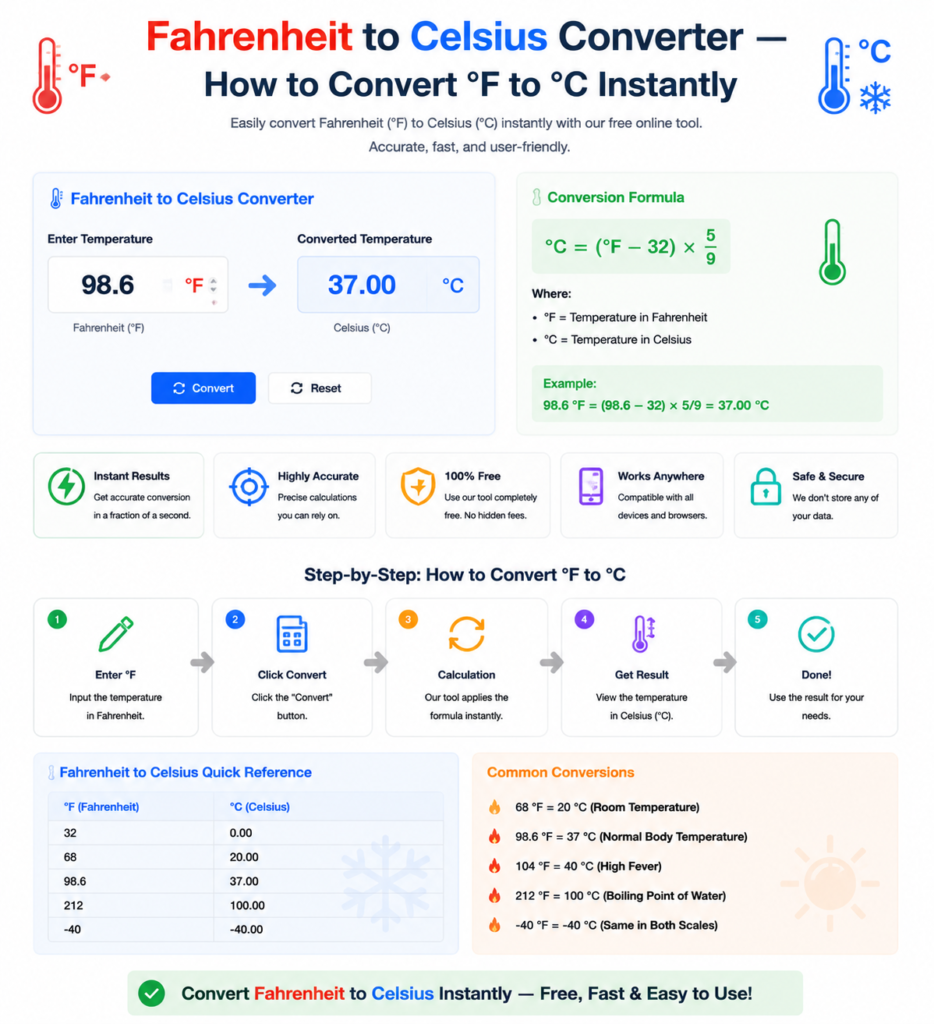
The mathematical formula to convert Fahrenheit to Celsius is:
°C = (°F − 32) × 5/9
Or equivalently:
°C = (°F − 32) ÷ 1.8
Step by step example — converting 98.6°F (normal body temperature):
- Subtract 32: 98.6 − 32 = 66.6
- Multiply by 5/9: 66.6 × 5 ÷ 9 = 37°C
And converting Celsius back to Fahrenheit:
°F = (°C × 9/5) + 32
Or: °F = (°C × 1.8) + 32
How to Use the Fahrenheit to Celsius Converter Online
Skip the maths entirely — use the free Fahrenheit to Celsius converter at OneClickPDFConvert for instant results:
Step 1 — Open the Converter
Go to oneclickpdfconvert.com and select the Fahrenheit to Celsius Converter. No account, no signup — results in seconds.
Step 2 — Enter the Temperature
Type the Fahrenheit temperature you want to convert — for example, 72.
Step 3 — Get Your Result
The converter instantly displays the Celsius equivalent. Most converters also show Kelvin for scientific use.
Common Fahrenheit to Celsius Conversions — Quick Reference Table
| Fahrenheit (°F) | Celsius (°C) | Context |
|---|---|---|
| -40°F | -40°C | Extreme cold — same value on both scales |
| 0°F | -17.8°C | Very cold winter temperature |
| 32°F | 0°C | Freezing point of water |
| 50°F | 10°C | Cool spring or autumn day |
| 59°F | 15°C | Mild temperature |
| 68°F | 20°C | Comfortable room temperature |
| 72°F | 22.2°C | Ideal indoor temperature |
| 77°F | 25°C | Warm summer day |
| 86°F | 30°C | Hot summer day |
| 95°F | 35°C | Very hot — heat advisory territory |
| 98.6°F | 37°C | Normal human body temperature |
| 100.4°F | 38°C | Low grade fever |
| 104°F | 40°C | High fever — seek medical attention |
| 212°F | 100°C | Boiling point of water |
| 350°F | 176.7°C | Common baking temperature |
| 375°F | 190.6°C | Medium oven temperature |
| 400°F | 204.4°C | Medium-high oven temperature |
| 425°F | 218.3°C | High oven temperature |
| 450°F | 232.2°C | Very high oven temperature |
A Quick Mental Trick for Approximate Conversion
The exact formula requires arithmetic — but for a quick rough estimate, this shortcut works well:
To convert °F to °C approximately: Subtract 30, then divide by 2
Example: 80°F → (80 − 30) ÷ 2 = 25°C (actual answer is 26.7°C — close enough for everyday use)
To convert °C to °F approximately: Multiply by 2, then add 30
Example: 25°C → (25 × 2) + 30 = 80°F (actual answer is 77°F — again, close enough for a quick estimate)
This trick won’t win you marks in a science exam — but it’s perfect for quickly making sense of a weather forecast or thermostat setting.
Why Do Some Countries Use Fahrenheit and Others Use Celsius?
It’s a fair question. The short answer is history and inertia.
Fahrenheit was developed by German physicist Daniel Gabriel Fahrenheit in 1724. It was widely adopted across Europe and its colonies. Celsius — developed by Swedish astronomer Anders Celsius in 1742 — uses a more logically structured scale based on water’s freezing and boiling points.
Most of the world switched to Celsius during the global adoption of the metric system in the 20th century. The United States, along with a small number of other countries, kept Fahrenheit — largely due to the cost and complexity of changing deeply embedded everyday systems.
Today, Fahrenheit is primarily used in the US for everyday weather and cooking, while Celsius is the global standard — and the only scale used in scientific contexts worldwide.
Fahrenheit vs Celsius — Key Reference Points
- Water freezes: 32°F = 0°C
- Water boils: 212°F = 100°C
- Body temperature: 98.6°F = 37°C
- Room temperature: 68-72°F = 20-22°C
- Equal temperature point: -40°F = -40°C (the only point where both scales are identical)
Fahrenheit to Celsius for Cooking
Cooking is one of the most common reasons people need to convert between Fahrenheit and Celsius — especially when following recipes from a different country.
US recipes typically use Fahrenheit for oven temperatures. UK, Australian, and European recipes use Celsius. Here are the most common oven temperature conversions:
| Description | Fahrenheit | Celsius | Gas Mark |
|---|---|---|---|
| Very low oven | 250°F | 120°C | ½ |
| Low oven | 300°F | 150°C | 2 |
| Moderate oven | 350°F | 175°C | 4 |
| Medium-high oven | 375°F | 190°C | 5 |
| Hot oven | 400°F | 200°C | 6 |
| Very hot oven | 450°F | 230°C | 8 |
| Extremely hot | 500°F | 260°C | 9 |
Fahrenheit to Celsius for Body Temperature
Understanding fever temperatures is important — especially for parents monitoring a sick child:
- Normal: 98.6°F (37°C)
- Low-grade fever: 99-100.4°F (37.2-38°C)
- Moderate fever: 100.4-103°F (38-39.4°C)
- High fever: 103-104°F (39.4-40°C) — consult a doctor
- Very high fever: Above 104°F (40°C) — seek immediate medical attention
Fahrenheit to Celsius for Weather
Travelling to the US from a metric country — or vice versa — means dealing with unfamiliar temperature scales in weather forecasts. Here’s a practical weather reference:
- Below 32°F (0°C) — Freezing. Ice possible. Heavy coat essential.
- 32-50°F (0-10°C) — Cold. Coat and layers needed.
- 50-68°F (10-20°C) — Cool to mild. Light jacket weather.
- 68-86°F (20-30°C) — Warm and comfortable. T-shirt weather.
- Above 86°F (30°C) — Hot. Stay hydrated. Sun protection needed.
- Above 95°F (35°C) — Very hot. Heat precautions essential.
What Is Kelvin and When Is It Used?
Kelvin is the third major temperature scale — used almost exclusively in science and engineering. Unlike Fahrenheit and Celsius, Kelvin starts at absolute zero — the theoretical point where all molecular motion stops.
- Absolute zero: 0K = -273.15°C = -459.67°F
- Water freezes: 273.15K = 0°C = 32°F
- Water boils: 373.15K = 100°C = 212°F
To convert Celsius to Kelvin: K = °C + 273.15
Kelvin is used in physics, chemistry, astronomy, and any field where absolute temperature measurements matter. For everyday purposes, Fahrenheit and Celsius are all you need.
Final Thoughts
Temperature conversion is one of those simple tasks that trips people up when they’re in a hurry. Whether you’re following a recipe, checking a weather forecast, monitoring a fever, or adjusting a thermostat — knowing how to switch between Fahrenheit and Celsius quickly makes life easier.
The formula is simple. The online converter is even simpler. Bookmark it for next time you need it.
👉 Convert Fahrenheit to Celsius free — try it now at OneClickPDFConvert
Frequently Asked Questions About Fahrenheit to Celsius Conversion
What is the formula to convert Fahrenheit to Celsius?
°C = (°F − 32) × 5/9. Subtract 32 from the Fahrenheit value, then multiply by 5 and divide by 9.
What is 100°F in Celsius?
100°F = 37.78°C. This is just above normal body temperature and indicates a low-grade fever.
What is normal body temperature in Celsius?
Normal body temperature is 98.6°F = 37°C.
At what temperature are Fahrenheit and Celsius the same?
At -40°. Both scales give the same reading at -40°F and -40°C.
What is 37°C in Fahrenheit?
37°C = 98.6°F — normal human body temperature.
What is room temperature in Celsius?
Comfortable room temperature is typically 20-22°C (68-72°F).
Is the Fahrenheit to Celsius converter free?
Yes — completely free. No account, no signup, instant results.
Why does the US still use Fahrenheit?
The US retained Fahrenheit due to historical adoption and the practical difficulty of changing deeply embedded everyday measurement systems. Scientific work in the US uses Celsius and Kelvin like everywhere else.